Posts

Showing posts with the label Ancoats

The Day Nursery

Image
  One of the lesser-known services of the first 50 years of the Charity’s history was the Day Nursery in Ancoats which operated for over a decade from 1887. The service was aimed at local working women who could pay two-pence a day for their child to be fed and cared for while she went out to work. An invaluable resource in industrial Manchester and an example of how the Charity operated services to meet a particular need of the times. The Nursery was originally located on Butler Street in Ancoats and it was at the request of the Day Nurseries Association that the Charity took over the service which moved within the first year to a premises a short distance away on the corner of Canning Street and Carruthers Street.  The Day Nursery, Ancoats ref: M189/9/1/5 The Charity magazine refers to the dangers of mothers being obliged to earn a wage and their children being injured after being left either uncared for or with unsuitable carers such as other young children or the very el...
A Russian connection

Image
The vast majority of children who entered the Manchester and Salford Boys’ and Girls’ Refuges and Homes were from Manchester and the surrounding areas. The charity began with the intention to take boys, and later girls, out of the city slums and give them safe, warm accommodation, where they could learn a trade and create a better life for themselves. A look at the admission books for the charity however, revealed that it was not just Mancunians who passed through the Refuge door.  Of course Manchester appealed to people from all over. The Industrial R evolution meant people had swarmed to the cities looking for work. Certain areas therefore became well known as settlements for different nationalities. Ancoats, for example, became well known as ‘ Little Italy ’, as poverty caused many Italians to move away from their homeland. Ancoats was also home to a large population of Irish workers, many of whom lived in the cellars of the small, cramped houses. Up in Salford and Prestwich,...

Helping generations of families

Image
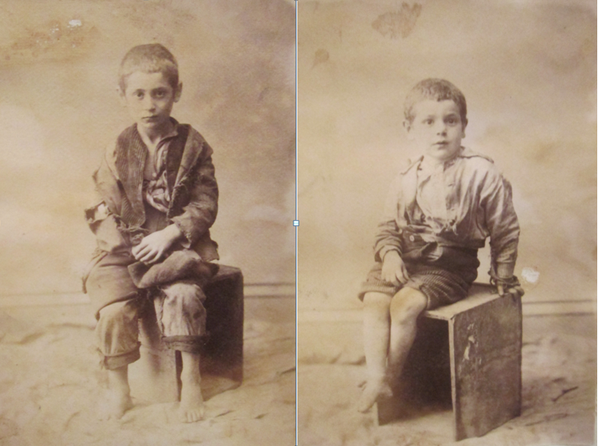
When the Manchester Refuges began in 1870 it catered for children in some of the most dire straits. The slum areas of Angel Meadow, Ancoats and Blackfriars spewed out dirty, ragged and half starved children that were often in need of assistance from the church or charities to avoid the dreaded shadow of the Workhouse .  In the Manchester Slums

Preventing Scuttling

Image
I was lent a book recently entitled, ' The Gangs of Manchester: The Story of The Scuttlers' by Andrew Davies . The book revolves around Manchester at the end of the nineteenth century and the turf wars which existed between groups of teenagers. Scuttlers belonged to their own distinct group; the Bengal Tigers, the Meadow Lads and the Pollard Street Scuttlers, to name a few, fiercely defended their own patch. Weapons included belt buckles and knives as well as the boy’s fists and feet. From 1870 the industrial slums of Manchester and Salford saw the emergence of a brutal gang culture that lasted for 30 years.  Strangeways Prison – A common sight to many a scuttler “A scuttler is a lad, usually between the ages of 14 and 18, or even 19, and scuttling consists of the fighting of two opposed bands of youths, who are armed with various weapons”. — Alexander Devine , Scuttlers and Scuttling: Their Prevention and Cure. (Manchester, 1890)  So how is this book relevan...